Tom Tate Tom Tate
0 Course Enrolled • 0 Course CompletedBiography
1z1-084 Valid Test Bootcamp, Online 1z1-084 Bootcamps
Real4exams has many Oracle Database 19c Performance and Tuning Management (1z1-084) practice questions that reflect the pattern of the real Oracle Database 19c Performance and Tuning Management (1z1-084) exam. Real4exams allows you to create a Oracle Database 19c Performance and Tuning Management (1z1-084) exam dumps according to your preparation. It is easy to create the Oracle 1z1-084 Practice Questions by following just a few simple steps. Our Oracle Database 19c Performance and Tuning Management (1z1-084) exam dumps are customizable based on the time and type of questions.
Oracle 1Z0-084 is an exam designed for professionals who want to enhance their knowledge and expertise in performance and tuning management of Oracle Database 19c. Oracle Database 19c Performance and Tuning Management certification exam is designed to validate the knowledge and skills of database administrators, performance analysts, and developers who are responsible for managing and tuning Oracle databases. 1z1-084 Exam Tests the candidate's ability to use various performance tuning tools and techniques to optimize database performance and ensure smooth operation.
To pass the Oracle 1Z0-084 exam, candidates must have a deep understanding of Oracle Database 19c architecture and its associated components. They should be able to identify and resolve performance issues using tools such as SQL Tuning Advisor, Automatic Workload Repository, and Oracle Enterprise Manager. Candidates should also be proficient in monitoring database performance and tuning system parameters to optimize database performance. Successful completion of the Oracle 1Z0-084 exam demonstrates a candidate's ability to manage and tune Oracle Database 19c systems effectively, making them a valuable asset to any organization that relies on Oracle Database technology.
>> 1z1-084 Valid Test Bootcamp <<
Online 1z1-084 Bootcamps - 1z1-084 Latest Test Online
The Oracle Database 19c Performance and Tuning Management certification has become very popular to survive in today's difficult job market in the technology industry. Every year, hundreds of Oracle aspirants attempt the 1z1-084 exam since passing it results in well-paying jobs, salary hikes, skills validation, and promotions. Lack of Real 1z1-084 Exam Questions is their main obstacle during 1z1-084 certification test preparation.
Oracle Database 19c Performance and Tuning Management Sample Questions (Q10-Q15):
NEW QUESTION # 10
Examine this AWR report excerpt: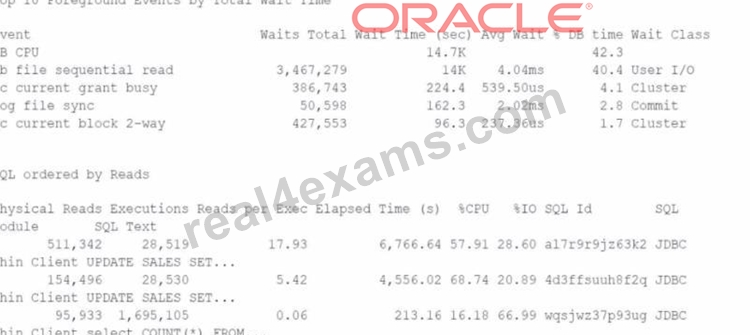
You must reduce the impact of database I/O, without increasing buffer cache size and without modifying the SQL statements.
Which compression option satisfies this requirement?
- A. COLUMN STORE COMPRESS FOR QUERY HIGH
- B. MN STORE COMPRESS FOR QUERY LOW
- C. STORE COMPRESS
- D. ROW STORE COMPRESS ADVANCED
Answer: A
Explanation:
The question asks to reduce database I/O impact without increasing the buffer cache size or modifying SQL statements. This indicates a need to reduce the physical I/O required to access the data. Let's analyze the scenario and the options.
Analysis of the AWR Report:
* Top Wait Events:
* The top foreground wait event is db file sequential read, which accounts for 40.4% of DB time.
This indicates significant physical I/O operations, primarily single-block reads, which are typically associated with index access.
* Reducing the physical I/O associated with db file sequential read can significantly improve performance.
* SQL Ordered by Reads:
* The SQL consuming the most reads involves high physical I/O. This confirms the need to reduce I
/O overhead by compressing data efficiently to minimize physical reads.
Compression Techniques and Their Suitability:
* A. COLUMN STORE COMPRESS FOR QUERY LOW:
* This option is a columnar compression method that optimizes for query performance but provides less compression compared to the HIGH option. While effective, it is not as suitable as FOR QUERY HIGH for reducing I/O.
* B. STORE COMPRESS:
* This is the basic compression option for tables and does not offer the advanced capabilities required for reducing significant physical I/O for queries.
* C. ROW STORE COMPRESS ADVANCED:
* This is a row-level compression that is suitable for OLTP workloads. While it reduces storage, it does not reduce query-related I/O as effectively as columnar compression.
* D. COLUMN STORE COMPRESS FOR QUERY HIGH (Correct Option):
* This is the most effective option for reducing query-related I/O. It:
* Uses columnar compression to reduce the size of data stored on disk.
* Reduces the number of physical reads by compressing data highly, meaning fewer blocks need to be read.
* Optimizes query performance for analytical workloads, which aligns with the scenario described in the AWR report.
Why COLUMN STORE COMPRESS FOR QUERY HIGH Is the Best Fit:
* It is designed to improve query performance by minimizing the amount of I/O required.
* Suitable for environments with heavy read operations (as indicated by the db file sequential read waits).
* Does not require changes to SQL or buffer cache size, adhering to the constraints in the question.
Reference to Oracle Documentation:
* Oracle Database 19c Performance Tuning Guide:
* Section: Using Compression to Reduce Storage and I/O Requirements.
* Discussion of columnar compression techniques for reducing I/O in query-intensive environments.
* Oracle Advanced Compression Documentation:
* Details on COLUMN STORE COMPRESS FOR QUERY HIGH and its benefits for analytical workloads.
NEW QUESTION # 11
What is the right time to stop tuning an Oracle database?
- A. When the allocated budget for performance tuning has been exhausted
- B. When the buffer cache and library cache hit ratio is above 95%
- C. When all the concurrency waits are eliminated from the Top 10
- D. When the I/O is less than 10% of the DB time
Answer: A
Explanation:
The right time to stop tuning an Oracle database is often determined by the point of diminishing returns - when the cost of further tuning (in terms of time, resources, or money) exceeds the performance benefits gained.
This is often related to the budget allocated for performance tuning.
* A (Correct):When the allocated budget for performance tuning has been exhausted, it may be time to stop tuning unless the benefits of further tuning justify requesting additional budget.
* B (Incorrect):Eliminating all concurrency waits from the Top 10 is an unrealistic goal since some waits are inevitable and can occur due to application design, which might not be possible to eliminate completely.
* C (Incorrect):The buffer cache and library cache hit ratio being above 95% does not necessarily indicate that the database is fully optimized. Hit ratios are not reliable indicators of database performance and should not be used as sole criteria to end tuning efforts.
* D (Incorrect):Having I/O less than 10% of DB time is not a definitive indicator to stop tuning. It is essential to consider the overall performance goals and whether they have been met rather than focusing solely on I/O metrics.
References:
* Oracle Database Performance Tuning Guide:Introduction to Performance Tuning
* Oracle Database 2 Day + Performance Tuning Guide:Understanding the Tuning Process
NEW QUESTION # 12
You want to reduce the amount of db file scattered read that is generated in the database.You execute the SQL Tuning Advisor against the relevant workload. Which two can be part of the expected result?
- A. recommendations regarding the creation of materialized views
- B. recommendations regarding the creation of SQL Patches
- C. recommendations regarding rewriting the SQL statements
- D. recommendations regarding partitioning the tables
- E. recommendations regarding the creation of additional indexes
Answer: A,E
Explanation:
The SQL Tuning Advisor provides recommendations for improving SQL query performance. This may include suggestions for creating additional indexes to speed up data retrieval and materialized views to precompute and store query results.References:
* Oracle Database SQL Tuning Guide, 19c
NEW QUESTION # 13
Which two statements are true about space usage in temporary tablespaces?
- A. When a session consumes all temporary tablespace storage, then the session would hang until the temporary space used by that session is cleared.
- B. A sort will fail if a sort to disk requires more disk space and no additional extent can be found/allocated in/for the sort segment.
- C. Temporary tablespaces setting Includes quotas to limit temporary space used by a session for that Temporary tablespace.
- D. When a global temporary table instantiation is too large to fit in memory, space is allocated in a temporary tablespace.
- E. Lack of temporary tablespace space for sort operations can be prevented by using temporary tablespace groups.
Answer: D,E
Explanation:
Regarding space usage in temporary tablespaces, the following statements are true:
* A (Correct):When a global temporary table or a sort operation exceeds the available memory, Oracle Database allocates space in a temporary tablespace to store the temporary data or intermediate results.
* E (Correct):Using temporary tablespace groups can prevent insufficient temporary tablespace for sort operations by providing a collective pool of space from multiple temporary tablespaces, which can be used for user sorting operations.
The other options provided have inaccuracies:
* B (Incorrect):Oracle does not provide a mechanism for setting quotas on temporary tablespaces. Quotas can be set for permanent tablespaces but not for temporary ones.
* C (Incorrect):A sort operation may fail due to insufficient space, but Oracle will attempt to allocate space in the temporary tablespace dynamically. If no space can be allocated, an error is returned rather than a sort failure.
* D (Incorrect):If a session consumes all available temporary tablespace storage, Oracle will not hang the session; it will return an error to the session indicating that it has run out of temporary space.
References:
* Oracle Database Administrator's Guide:Managing Space for Schema Objects
* Oracle Database Concepts:Temporary Tablespaces
NEW QUESTION # 14
Examine these commands, which execute successfully:
Which statement is true?
- A. AWR snapshots can be purged manually in pluggable databases.
- B. AWR- snapshots in all pluggable databases will be purgedautomatically after every 60 mins.
- C. AD DM is enabled for all pluggable databases.
- D. ADDM, AWR, and ASH reports can be purged automatically.
Answer: A
Explanation:
TheDBMS_WORKLOAD_REPOSITORY.MODIFY_SNAPSHOT_SETTINGSprocedure allows setting attributes related to AWR snapshots. While the interval setting controls the frequency of snapshot generation, purging them is a separate process that can be managed either automatically (with retention settings) or manually.References:
* Oracle Database PL/SQL Packages and Types Reference, 19c
* Oracle Multitenant Administrator's Guide, 19c
NEW QUESTION # 15
......
The Real4exams is one of the best platforms that has been helping Oracle 1z1-084 certification exam candidates for many years. Over this long time period, the Oracle Database 19c Performance and Tuning Management 1z1-084 exam questions helped many Oracle Database 19c Performance and Tuning Management 1z1-084 exam candidates to pass their certification exam. Now the Oracle Database 19c Performance and Tuning Management 1z1-084 Exam Questions have become the first choice for instant and complete 1z1-084 exam preparation. As far as the standard of 1z1-084 real questions is concerned, the Oracle Database 19c Performance and Tuning Management 1z1-084 actual questions are designed and verified by qualified Oracle 1z1-084 exam trainers.
Online 1z1-084 Bootcamps: https://www.real4exams.com/1z1-084_braindumps.html
- High Pass-Rate 1z1-084 Valid Test Bootcamp | Easy To Study and Pass Exam at first attempt - Excellent 1z1-084: Oracle Database 19c Performance and Tuning Management 🐭 ▛ www.real4dumps.com ▟ is best website to obtain ⮆ 1z1-084 ⮄ for free download 🎴1z1-084 Exam Testking
- Free PDF Quiz 2025 Accurate Oracle 1z1-084: Oracle Database 19c Performance and Tuning Management Valid Test Bootcamp 🗺 The page for free download of [ 1z1-084 ] on ➥ www.pdfvce.com 🡄 will open immediately 🍳1z1-084 Exam Testking
- Free PDF Quiz 2025 Accurate Oracle 1z1-084: Oracle Database 19c Performance and Tuning Management Valid Test Bootcamp 🥃 Immediately open 【 www.actual4labs.com 】 and search for ⮆ 1z1-084 ⮄ to obtain a free download 🛶1z1-084 Official Study Guide
- Try Oracle 1z1-084 Dumps To Conquer Success in One Go [2025] 🕗 Download ➥ 1z1-084 🡄 for free by simply entering ➠ www.pdfvce.com 🠰 website 🏜Well 1z1-084 Prep
- Authentic 1z1-084 Exam Questions 👪 1z1-084 Relevant Questions 🤸 Authentic 1z1-084 Exam Questions 🏖 Open ➡ www.examsreviews.com ️⬅️ and search for ✔ 1z1-084 ️✔️ to download exam materials for free 🎷1z1-084 Exam Testking
- Authentic 1z1-084 Exam Questions 🧼 Latest 1z1-084 Demo ✍ Valid Test 1z1-084 Tutorial 🚍 Copy URL ⮆ www.pdfvce.com ⮄ open and search for 「 1z1-084 」 to download for free 🖖Latest 1z1-084 Test Cram
- Try Oracle 1z1-084 Dumps To Conquer Success in One Go [2025] 🔉 The page for free download of ➤ 1z1-084 ⮘ on ▶ www.passtestking.com ◀ will open immediately 🧦Latest 1z1-084 Demo
- 1z1-084 Knowledge Points 😭 1z1-084 Actual Exam Dumps 😂 1z1-084 New Test Camp 🍞 The page for free download of ➤ 1z1-084 ⮘ on ( www.pdfvce.com ) will open immediately 🧦1z1-084 New Test Camp
- 1z1-084 Actual Exam Dumps 🎽 Exam 1z1-084 Discount ❇ 1z1-084 Practice Questions 🕦 Search for ☀ 1z1-084 ️☀️ and obtain a free download on 「 www.examcollectionpass.com 」 👋Valid Test 1z1-084 Tutorial
- 100% Pass Rate 1z1-084 Valid Test Bootcamp Covers the Entire Syllabus of 1z1-084 🐾 Immediately open ➥ www.pdfvce.com 🡄 and search for ▛ 1z1-084 ▟ to obtain a free download ⛵1z1-084 Reliable Test Topics
- Free PDF Quiz Trustable Oracle - 1z1-084 - Oracle Database 19c Performance and Tuning Management Valid Test Bootcamp 🚧 ➥ www.torrentvce.com 🡄 is best website to obtain “ 1z1-084 ” for free download 🧟1z1-084 Exam Testking
- pct.edu.pk, accofficial.in, digitalmasterclass.net, isd-data.net, growthhackingcourses.com, learnyble.com, uniway.edu.lk, motionentrance.edu.np, elcenter.net, motionentrance.edu.np